Notes from my research on Francesco Piersigilli, my great-great-grandfather. I write down three different things: what I found in the documents, what I was told, and what I only think. They are not the same thing, and I try to keep them apart.
A photograph
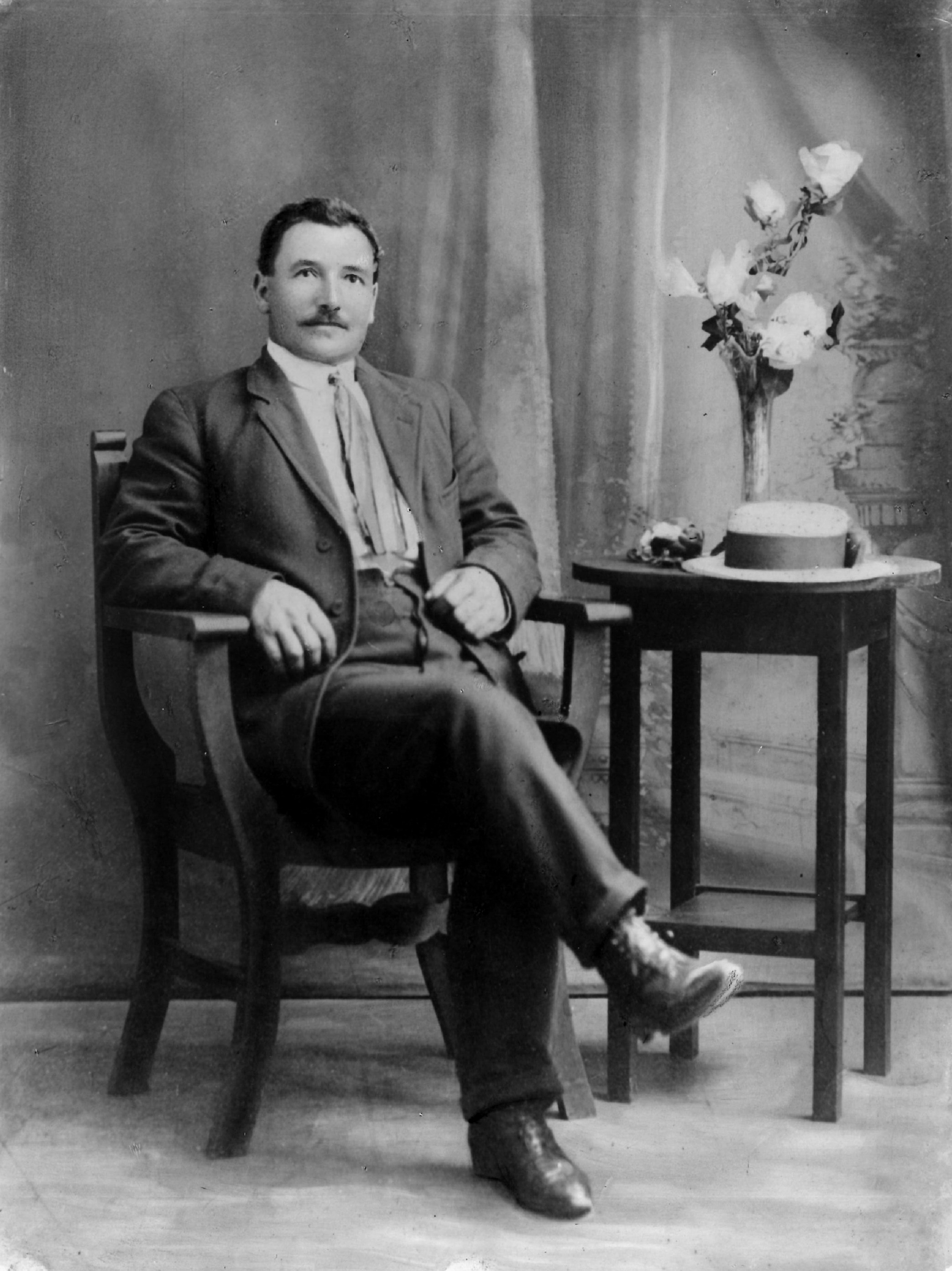
My grandfather passed it down to me. It is almost all the family has left of him. A man sitting on a wooden chair, dark jacket, striped tie, legs crossed. Beside him, on a small table, a hat and some flowers. It is a very theatrical hat, and I believe it was part of the photo studio's set. Nothing is written on the back: no date, no stamp. From the clothes I would say the early 1900s.
I like to think he had it taken before he left. That is what I think, not what I know. The hat, I think, was not his either: the studio staged it, like the flowers.
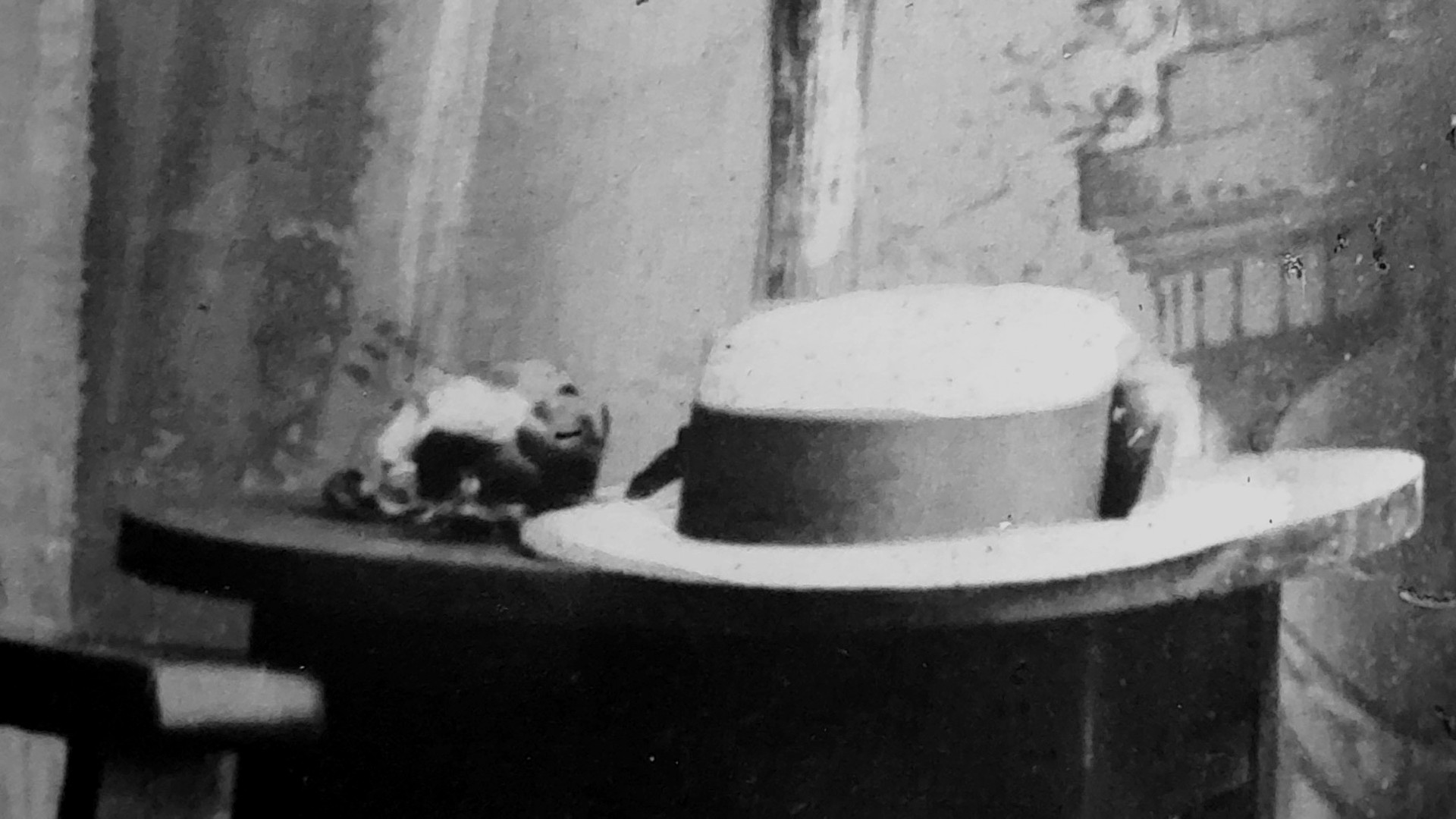
When I film it, I will start from the hat. It is the detail that holds me most, because it is the only one I cannot explain. I will leave his face for last.
Via Casigliano, house 78
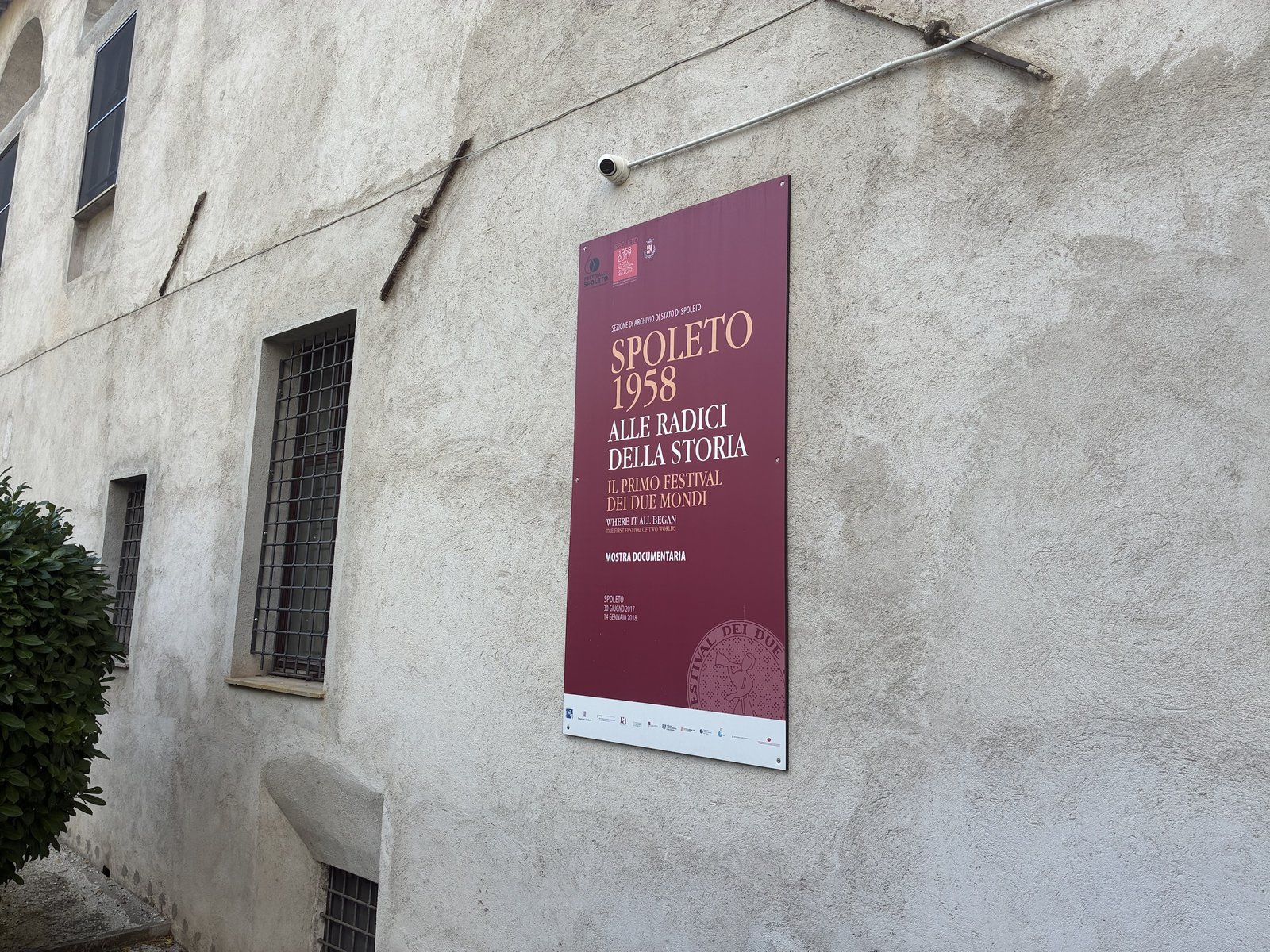
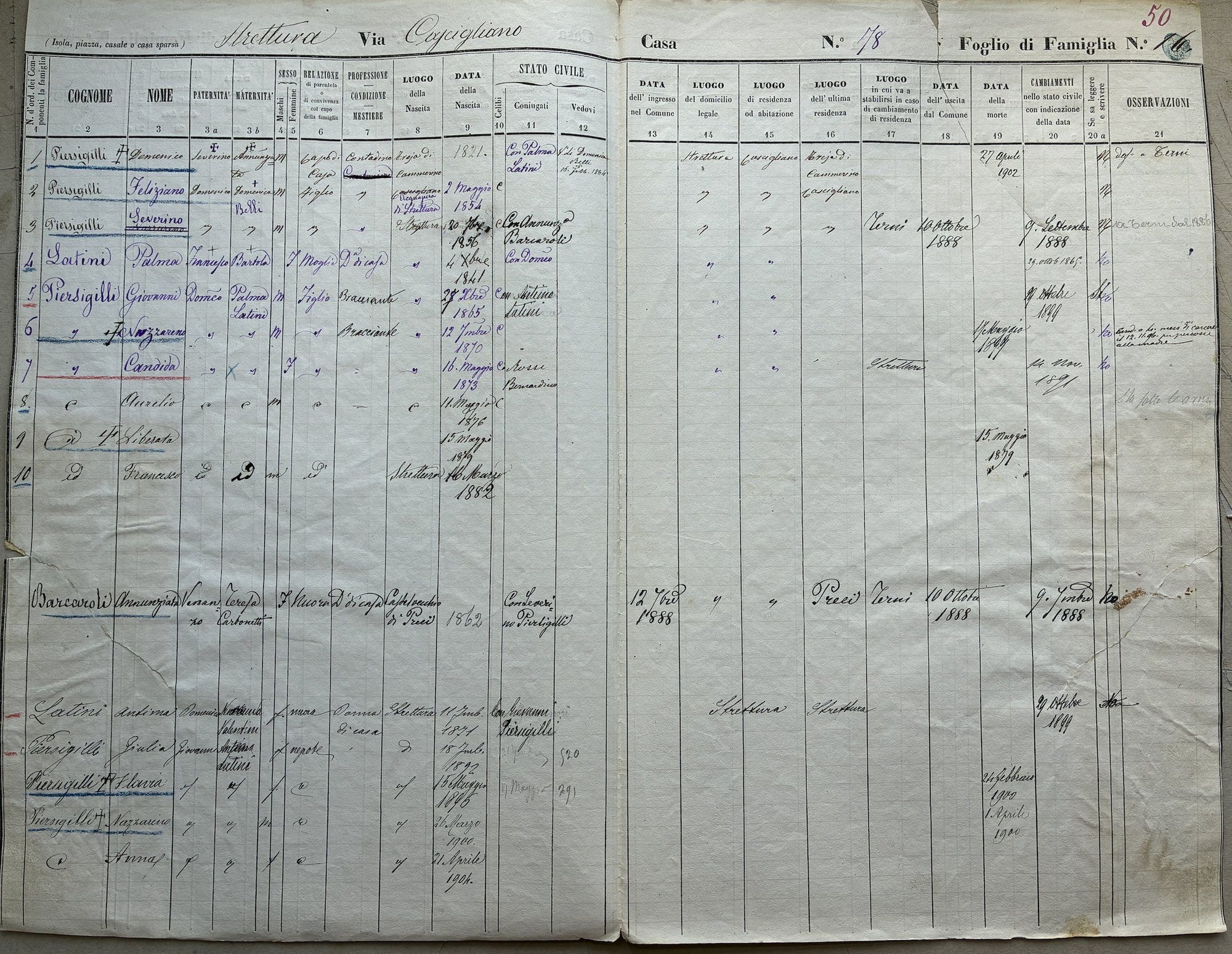
At the Archivio di Stato in Spoleto I found the family Francesco was born into. The family sheet for Strettura, Via Casigliano, house number 78 (Casigliano is a hamlet near Strettura, in the municipality of Spoleto, Umbria). The first ten lines hold the parents and their eight children. Francesco is the youngest, on line 10: born on March 16, 1882.
His father, Domenico, was a farmer, born in 1821: when Francesco is born he is sixty. His mother, Palma Latini, is forty. Domenico had lost his first wife, Domenica Belli, in 1864, and had two sons with her, Feliziano and Severino. With Palma more children follow: Giovanni, Nazzareno, Candida, Aurelio, Liberata, who died the day she was born, and finally Francesco.
Nazzareno, his brother, dies in 1899 at twenty-eight. Years later one of Francesco's sons will be called Nazareno. I think in his memory, but I do not know.
And then there is Terni, which keeps coming back. His half-brother Severino moves there in 1888. His father Domenico dies there in 1902. And in 1905 Girolamo Amici leaves for America "from Terni". For this family Terni was the nearby city, and I think it was the first place to go looking for work.
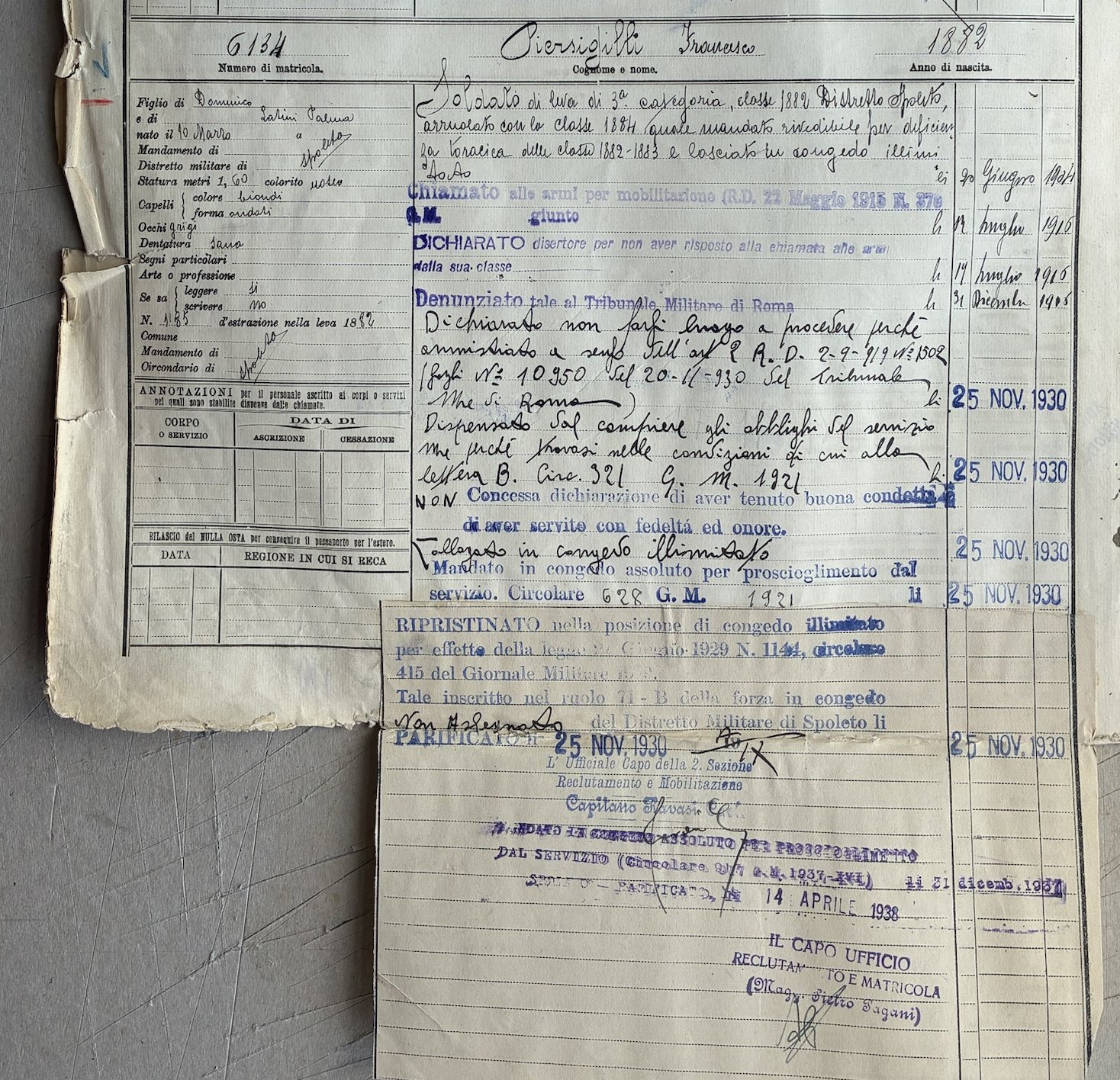
The same archive holds his foglio matricolare, his military record. Service number 6134. Five foot three, fair wavy hair, grey eyes, a rosy complexion. He could read, but not write.
On the 1913 manifest the Americans write brown hair and brown eyes. And the American draft card has him born on May 16, not March 16: the same day, a different month. Like his surname, his birth date changed on the way across the ocean.
At his military medical he is found to have a weak chest and is deferred. In 1904 he is enlisted in the third category and sent home: he never does military service.
Then the war comes. In July 1916 Italy calls him up. Francesco is in Trenton, at Roebling, and does not report. On July 17, 1916 he is declared a deserter, and in December he is reported to the Military Tribunal in Rome. It happened to thousands of emigrants.
What struck me most comes later. On November 25, 1930 the tribunal closes the case: no proceedings, because Francesco falls under the 1919 amnesty. But by 1930 Francesco had been dead for twelve years. On paper, for the Italian army, he was still alive. Perhaps the news of his death never reached the offices in Spoleto. That is the next thing I am looking for.
A handwritten sheet
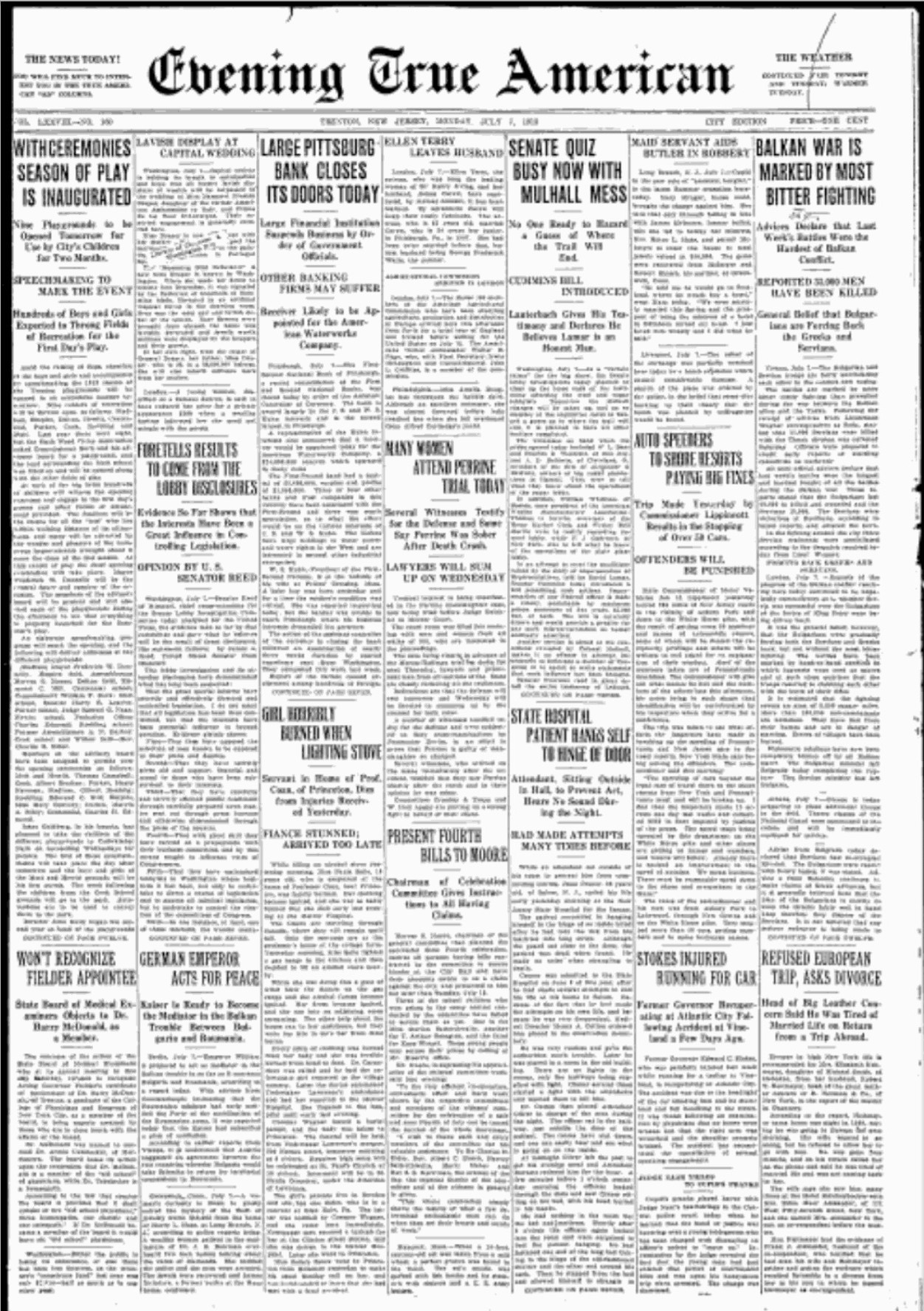
On September 3, 1913 the ship Mendoza, from Naples, arrives in New York. On the passenger list is Francesco Piersigilli, thirty-two, married, from Strettura. He is going to Trenton, New Jersey, to his brother-in-law Girolamo Amici.
On the second half of the sheet, on his line, the column "Has he ever been in the United States before?" says: yes, 06-09, Trenton. So he had already been to Trenton, from 1906 to 1909. When he leaves in 1913 he is not heading into the unknown: he is going back to a city he knows. Next to it is the address he is going to, 721½, Trenton. Height five feet four inches, brown hair and eyes, born in Spoleto.

In the film my hand moves slowly along this line. I stop on his name and cut there.

Who was waiting for him
Eight years before Francesco, on April 24, 1905, a Girolamo Amici lands in New York. Twenty-five, single, laborer, last residence Terni. He is going to Trenton, to his brother Adolfo.
In 1913, on Francesco's line, it only says he is going to his brother-in-law Girolamo Amici. No document says whose brother Girolamo was. But Marianna, Francesco's wife, was an Amici: most likely Girolamo and Adolfo were her brothers.
That the Girolamo of 1905 is the same man is very likely. The place of origin, the age and the brother Adolfo already in Trenton all fit. But I have not fully proved it yet, and an online family tree gives him dates that do not quite match. That is why I write that it is most likely him, and nothing more.
If it is him, Francesco did not arrive in an empty place. Someone from the family was waiting for him, and had opened the way eight years earlier.

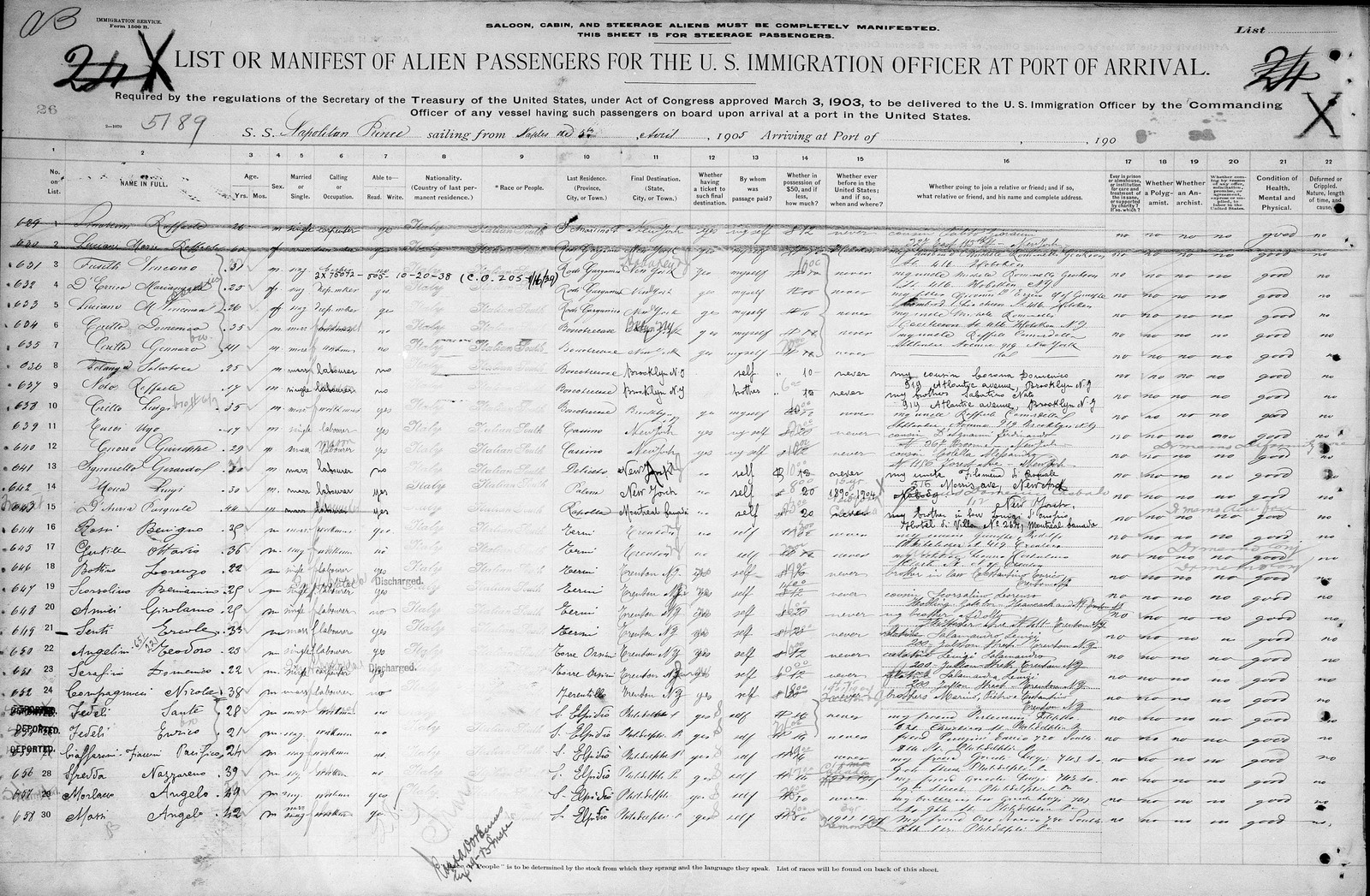
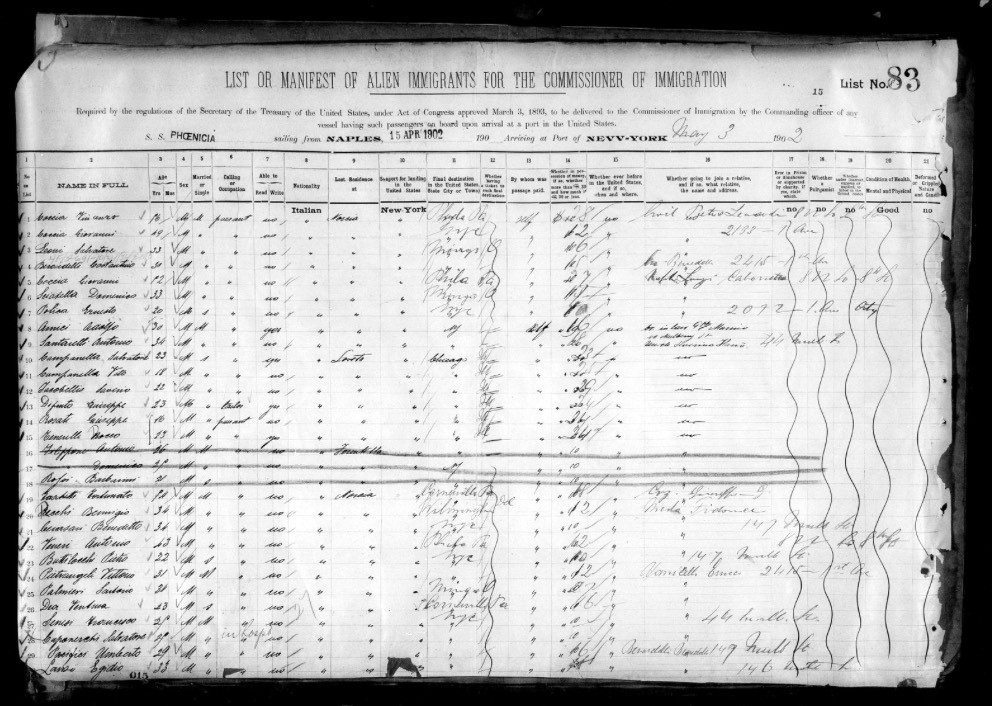
Three years before Girolamo, in May 1902, an Adolfo Amici arrives in New York on the ship Phoenicia: thirty, married, able to read and write. Girolamo joining an Adolfo already in America in 1905 follows the pattern of so many brothers at the time: one leaves, the other follows. Most likely they are brothers.
One thing does not add up, though. The Adolfo of 1902 was born around 1872, while the Adolfo Amici buried in Trenton is recorded as born in 1885. They could be two different people with the same name, an uncle and a nephew for example, as often happened. The birth records, between Morro Reatino and Terni, will tell.
A surname that changes
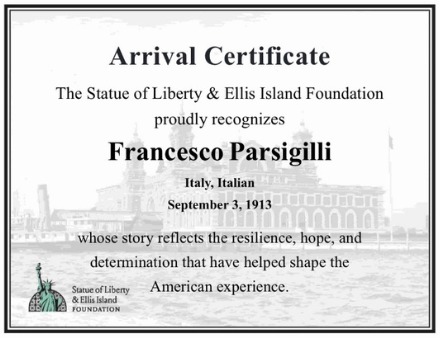
On the ship his surname is spelled right, Piersigilli. Then the American documents change it on every sheet: Pressigilli on the draft card, Piersigiti on the death certificate. And in the online index of the manifest, whoever transcribed it read Parsigilli. To find him I had to search for all of them. One wrong letter and an archive cannot find him.
1918
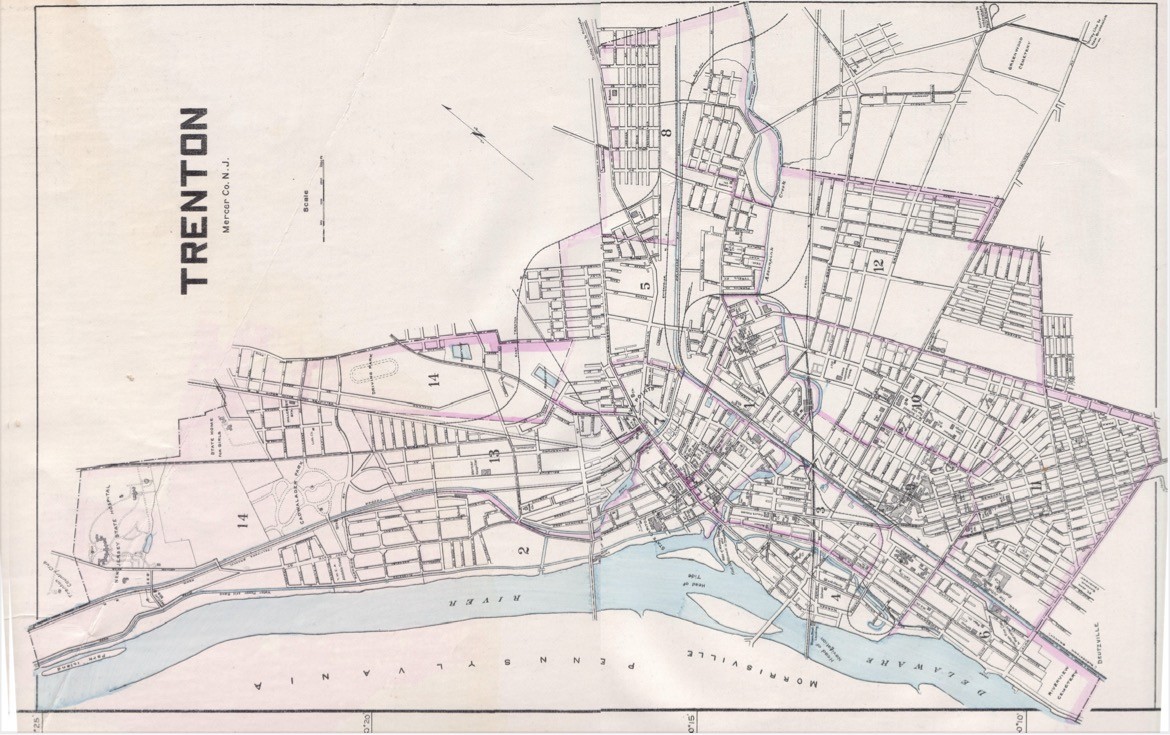
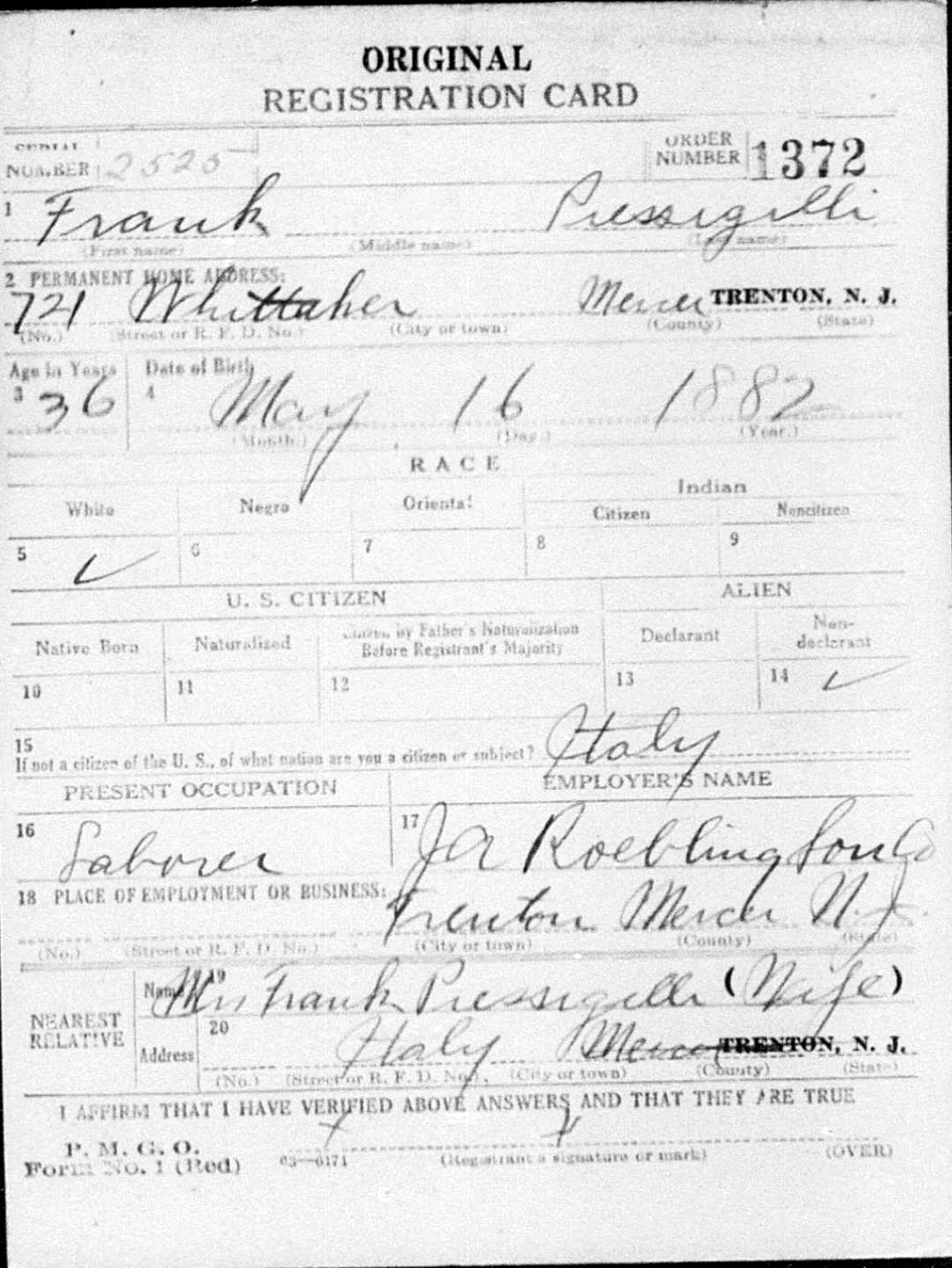
On September 12, 1918 he fills in his draft card. It reads Frank Pressigilli, born May 16, 1882 (Italian records say March 16), laborer at Roebling, the wire rope works. He lives at 721 Whitaker Avenue, Trenton. As nearest relative he gives his wife, and for her address they write only: Italy. On October 6, less than a month later, he dies. He was thirty-six.
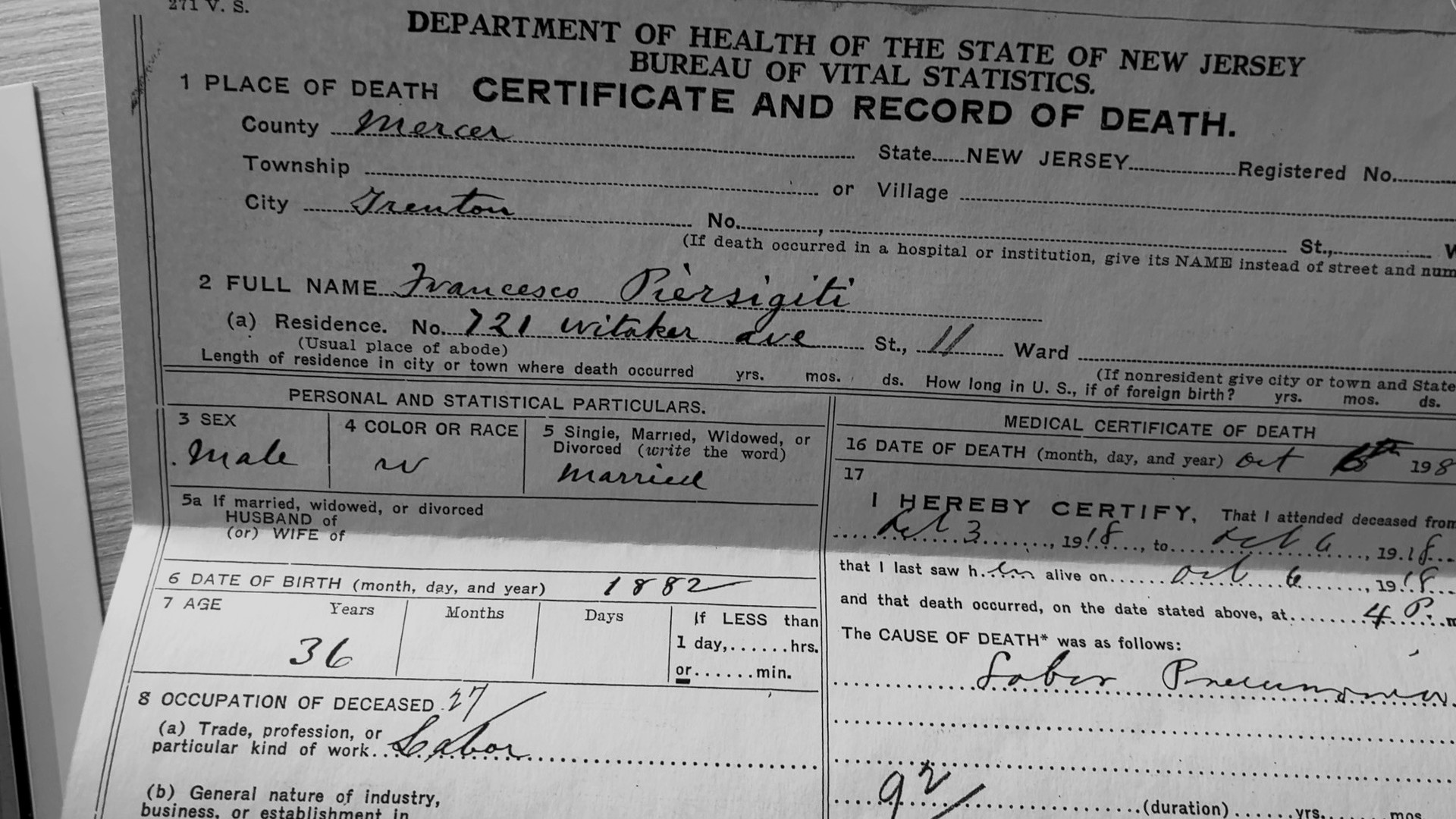
In the family it has always been said that he died of the Spanish flu. The certificate says lobar pneumonia. The two do not contradict each other: in 1918 the Spanish flu killed almost always through the pneumonia that followed the influenza, and certificates often recorded only that. Francesco dies on October 6, the same day Trenton is put under quarantine because of the epidemic.
The neighbours on Whitaker Avenue
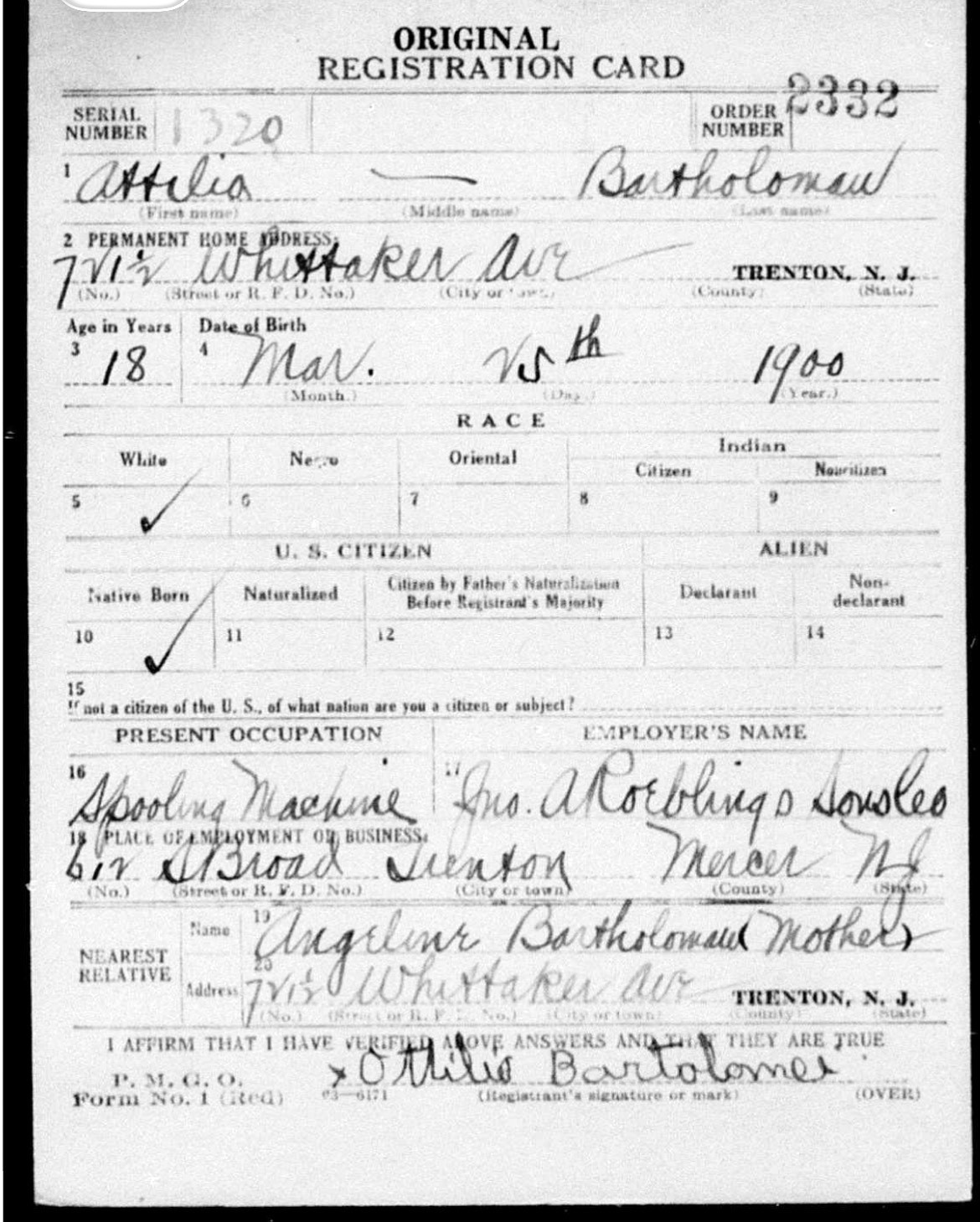
At 721½ Whitaker Avenue, in the same house as Francesco, lived Ottilio (or Attilio) Bartolomei. On his 1918 draft card the clerk writes Attilio Bartholomew, but at the bottom he signs Ottilio Bartolomei. Attilio was a far more common name at the time; Ottilio is very rare. Perhaps he was born in America and spelled his name the way he heard it said. Here I call him what he signed himself, Ottilio. Eighteen, born in the United States, he worked at Roebling on a machine that wound wire onto reels. His mother was called Angelina.
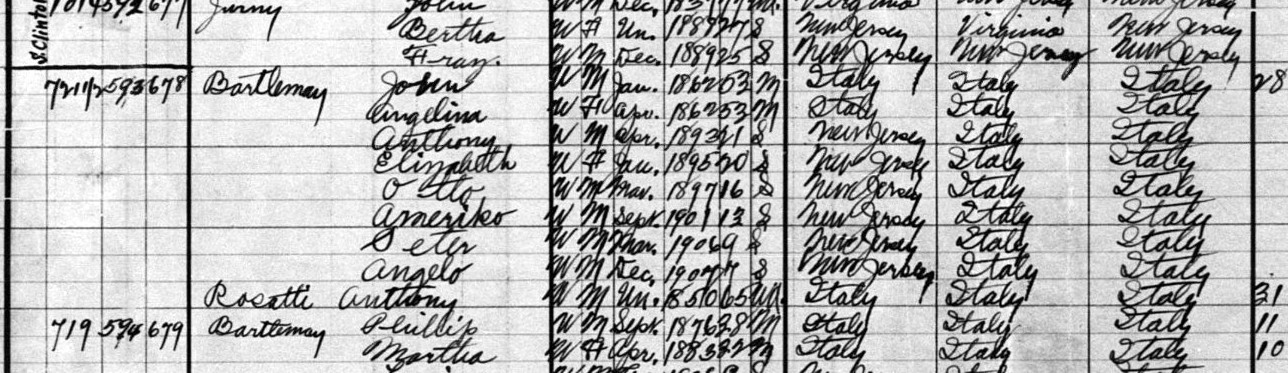
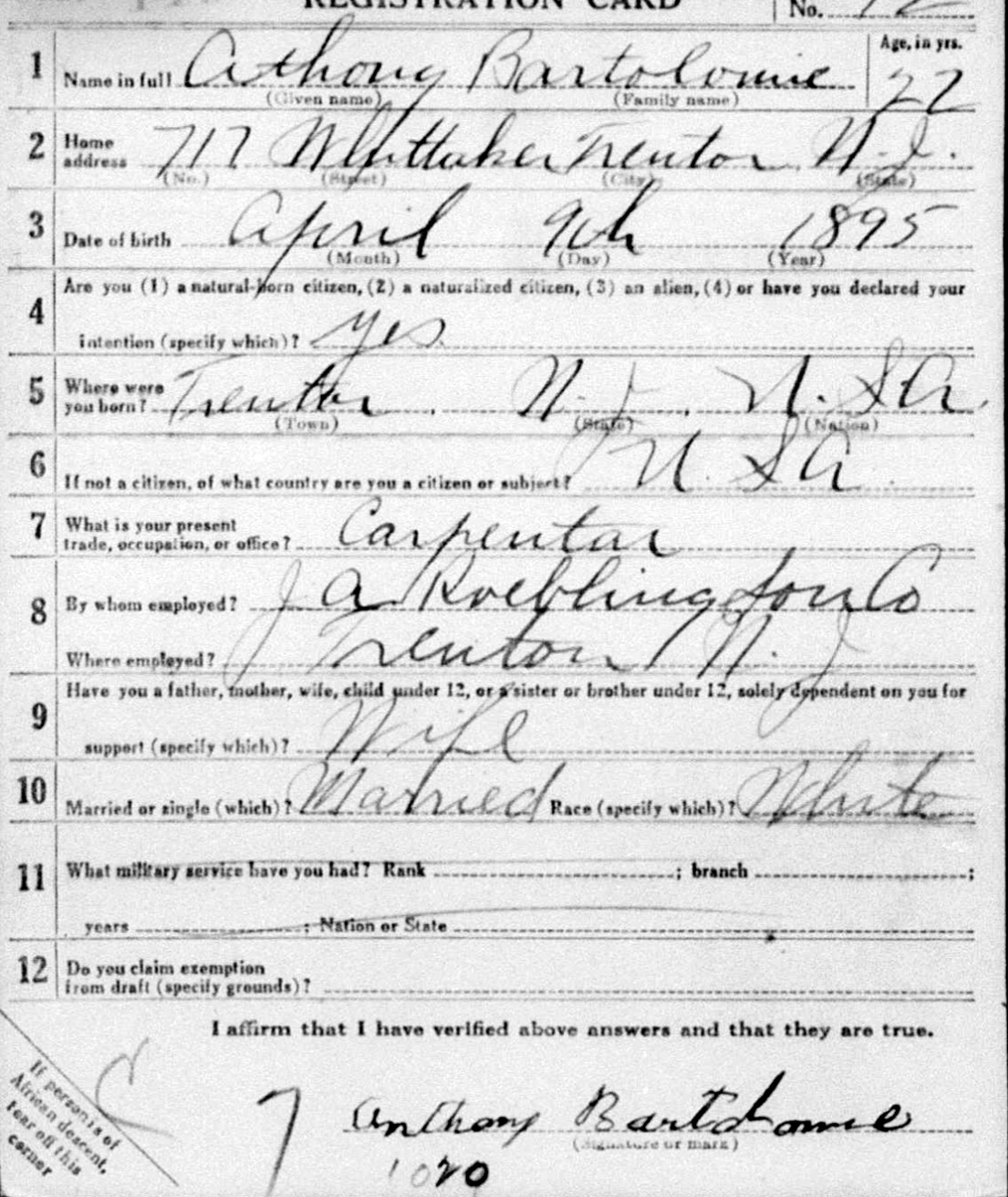
The house belonged to the Bartolomei family. In the census of June 14, 1915, at 721½ Whittaker Avenue, the whole family is there: John, a wire drawer, twenty-eight years in America, his wife Angelina, their children Anthony, Elizabeth, Otto (that is, Ottilio), Amerigo, Peter and Angelo, and a boarder, Anthony Rocatti. In 1917 Anthony, twenty-two, a carpenter at Roebling, gives his address as 717, two numbers down.
Francesco is not on that list. And yet in 1913, on the manifest, 721½ is the address he is going to, and in 1918 he lives there. Every document I have puts him there, before and after. In all likelihood he was at Roebling that Monday in June, and whoever opened the door to the census taker did not name the boarder who was not at home.
On Francesco's death certificate the informant, the person who gives the office the details of the deceased, is Ottelio, at 721 Whitaker Avenue. The clerk wrote Francesco's surname next to him, Piersigilli. But it is him, Ottilio Bartolomei: the same very rare name, the same house. The one who reported Francesco's death was an eighteen-year-old who lived with him.
In the 1919 Trenton city directory, the year after his death, Richetto Dolci, a rubber worker, is also listed at 721 Whittaker Avenue. Many people lived in that house.
The tickets
This is what I was told: in 1918 Francesco had sent tickets to his wife and their three children, who were between two and seven years old when he left. They were ready to leave when the news arrived.
I have found no document that confirms it. I do not know what happened to the tickets, and I do not know whether they arrived before or after the news.
Those who stayed
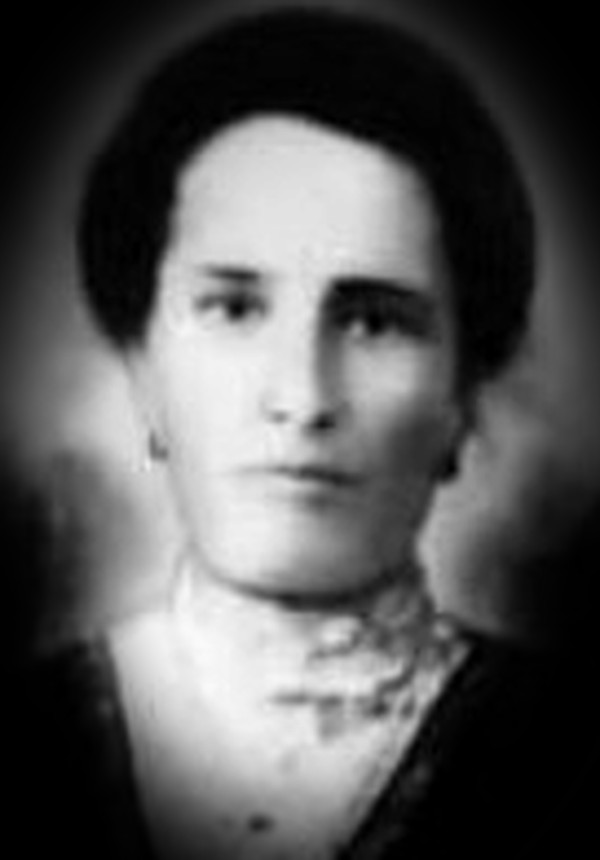
Marianna Amici, his wife, was born on August 25, 1881. When Francesco leaves in 1913 she is thirty-two; when he dies she is thirty-seven. She dies on March 6, 1964. She was a widow for forty-six years, and her name stayed bound to his: Amici Marianna, widow Piersigilli.
Domenico, one of their two sons, was born on August 10, 1906, the year Francesco first left for Trenton. I do not know whether his father was still at home when he was born. When Francesco dies, Domenico is twelve. He stays in Strettura all his life and dies on April 3, 1992.
What I have not found
The Roebling Museum has no photographs or papers concerning him. On his draft card he is recorded as an alien, an Italian citizen, who had not even filed his first papers for citizenship. The New Jersey State Archives found no naturalization for him. There is no record that he was an American citizen. In the Archivio di Stato in Spoleto I found his family sheet and his military record. I have not yet found an Italian transcription of his death record.
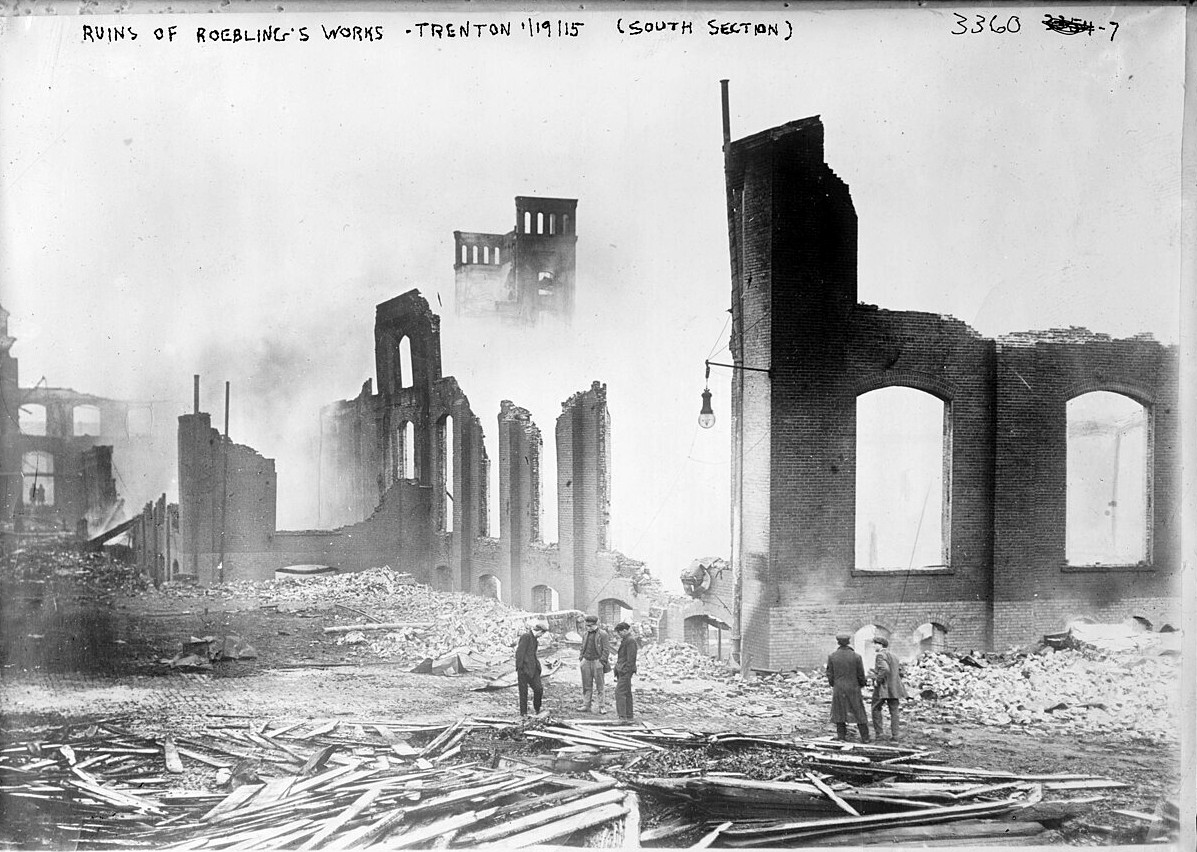
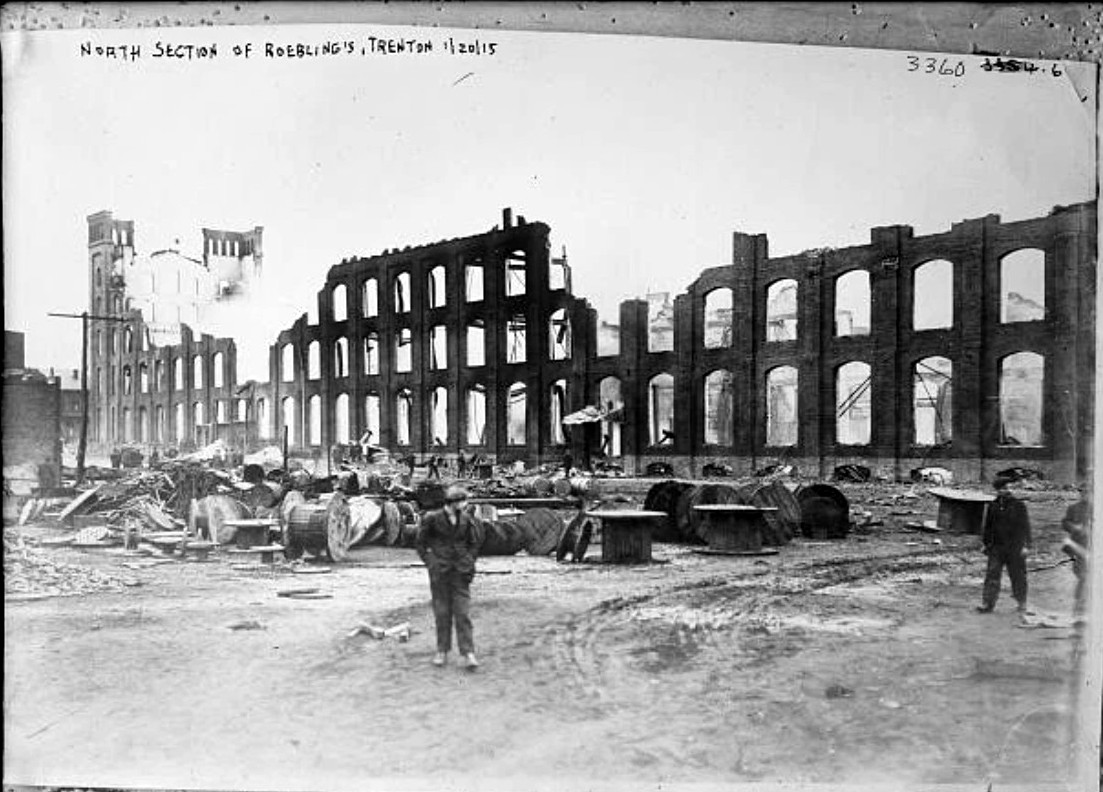
But I think he meant to stay. The tickets say so, if the family story is true: if you send tickets to your family, it means you are staying. A fact says so too, and this one is in the documents. In January 1915 the factory where he works burns down, a little over a year after he arrived. He does not go back. In September 1918 the draft card still places him in Trenton, still at Roebling.
Where he rests
I know which cemetery he is buried in: the certificate says so. I do not yet know where in it. When I find out, I will not write it here. That belongs to him.
If I film it, a gate with no name, the grass and the sky will be enough. No headstones in the frame. How long to stay on the sky I do not know yet: I will decide on the spot.
This diary grows as I keep searching.